
Hearing, Aging, and the Power of Audible Technology
When we begin caring for our aging parents, we focus on what we can see — their health, their routines, their safety. Hearing rarely makes that list.
Yet it’s often the first quiet loss — not just of sound, but of connection, confidence, and presence.
In our own family, it showed up in small moments before it ever felt like a problem. Asking us to repeat ourselves. Conversations that took more effort than they used to. A growing preference for silence — not because it was wanted, but because listening had become tiring.
There were moments that stayed with us. Then came the moments that quietly broke our hearts. When one of us raised our voice — not out of frustration, but love. Simply because we wanted our dad to hear us.
It seems small. It’s deeply human. And it’s happening in millions of families every day.
That’s when we began to understand something deeper: hearing isn’t passive. It’s how people stay oriented to the world around them. How they feel safe. How they remain connected.
And when it begins to fade, the loss is often invisible — unfolding quietly across the body, the mind, and daily life — long before it’s ever named or addressed.

Why Hearing Matters More Than We Realize
The ear is not just a sensory organ. It is a gateway.
Hearing allows older adults to:
- Stay engaged in conversation
- Interpret their environment
- Support balance, posture, and safe movement through auditory and vestibular cues
- Maintain spatial awareness
- Process information without cognitive overload
When hearing begins to decline, the brain doesn’t simply “hear less.” It works harder — constantly filling in gaps, guessing at meaning, compensating for missing signals. Over time, that effort comes at a cost.
According to the National Institute on Deafness and Other Communication Disorders, hearing loss is one of the most common chronic conditions affecting older adults — and yet, it remains one of the most under-treated.
That gap between impact and action is where many families quietly struggle.
The Purpose of the Ear: More Than Sound
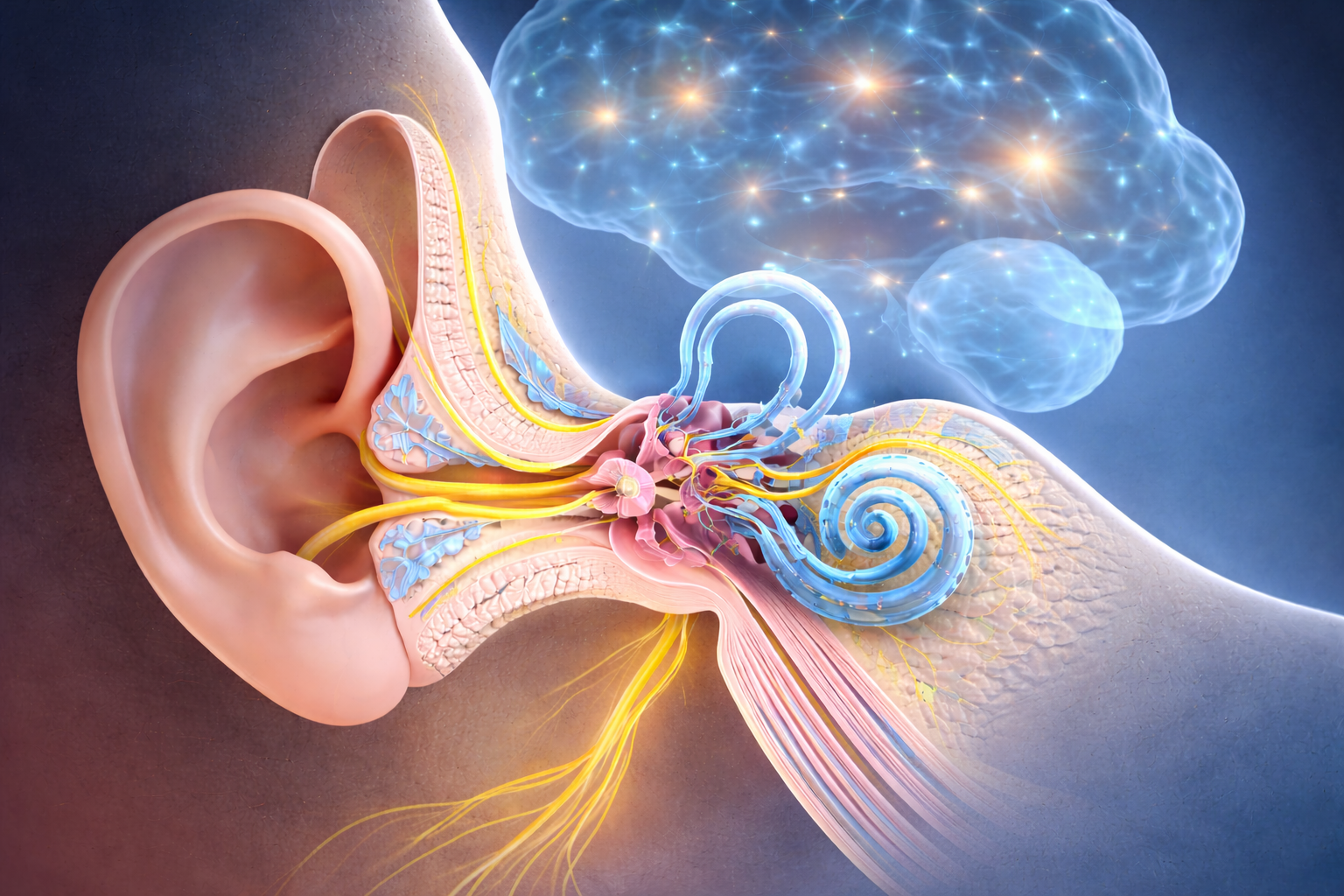
Hearing is deeply intertwined with how the brain understands the world — but sound is only part of the story.
The inner ear also houses the vestibular system, which plays a critical role in balance, spatial orientation, and coordinated movement.
As we age, hearing loss is often accompanied by:
- Increased risk of falls
- Dizziness or unsteadiness
- Difficulty navigating uneven or unfamiliar environments
- Reduced confidence in movement
This is not coincidence. It’s biology.
Falls, Balance, and Sensory Decline
Falls are one of the leading causes of injury and hospitalization among older adults.
When auditory or balance signals become unreliable, the brain loses essential information it depends on to maintain stable movement, posture, and situational awareness.
When hearing, balance, and other sensory inputs decline together, the risk compounds — not just to physical safety — but to confidence, mobility, and independence.
Hearing Loss and the Aging Brain
Over the past decade, research has fundamentally changed how we understand hearing loss.
A landmark Johns Hopkins study found that untreated hearing loss significantly increases the risk of cognitive decline and dementia.
- Reduced auditory input accelerates brain atrophy
- Cognitive load increases as the brain struggles to decode sound
- Social withdrawal compounds neurological decline
Hearing loss isn’t just about ears. It’s about the brain losing access to meaningful input.
When Hearing Loss Becomes Isolation
Older adults with untreated hearing loss are more likely to:
- Avoid social interaction
- Experience depression and anxiety
- Misinterpret conversations
- Lose confidence in public settings
Isolation is rarely chosen. It’s often adaptive — a way to avoid embarrassment, exhaustion, or misunderstanding.
Technology that restores hearing doesn’t just restore sound. It restores belonging.
Why iiAI Is an Audible Device
iiAI supports independence by:
- Reducing the need for constant manual adjustment
- Improving clarity without taxing cognition
- Integrating naturally into daily life — without screens or constant attention
Audible care is less invasive. It preserves dignity. And it gives caregivers visibility without taking control away.
Audible Technology: Beyond Amplification
- Conversations overlap
- Environments shift
- Listening becomes cognitively exhausting
AI-enabled audible technology helps filter sound so attention returns to:
- The person
- The moment
- The connection
Listening Is an Act of Care
Care is not about control. It’s about understanding — early, respectfully, and without stripping autonomy.
Learn more at https://ii-goodai.com