
AI for Aging Independence: Being There Without Being There
Right now, my siblings and I are caring for our father from miles away.
Not in the way we once imagined. Not by sitting beside him together, not by reading his face in real time or catching the subtle shifts as they happen. We care for him through a CCTV camera mounted quietly in his room, and through FaceTime calls that offer just enough reassurance to let us breathe.
We check the feed more often than we admit.
We watch how he moves.
We notice how long it takes him to stand.
We look for what’s different today.
And beneath it all is a quiet, shared fear many families carry: What if we miss something that matters?
Technology makes this possible, and for that we are deeply grateful.
But it has also made one thing unmistakably clear: Seeing is not the same as understanding.
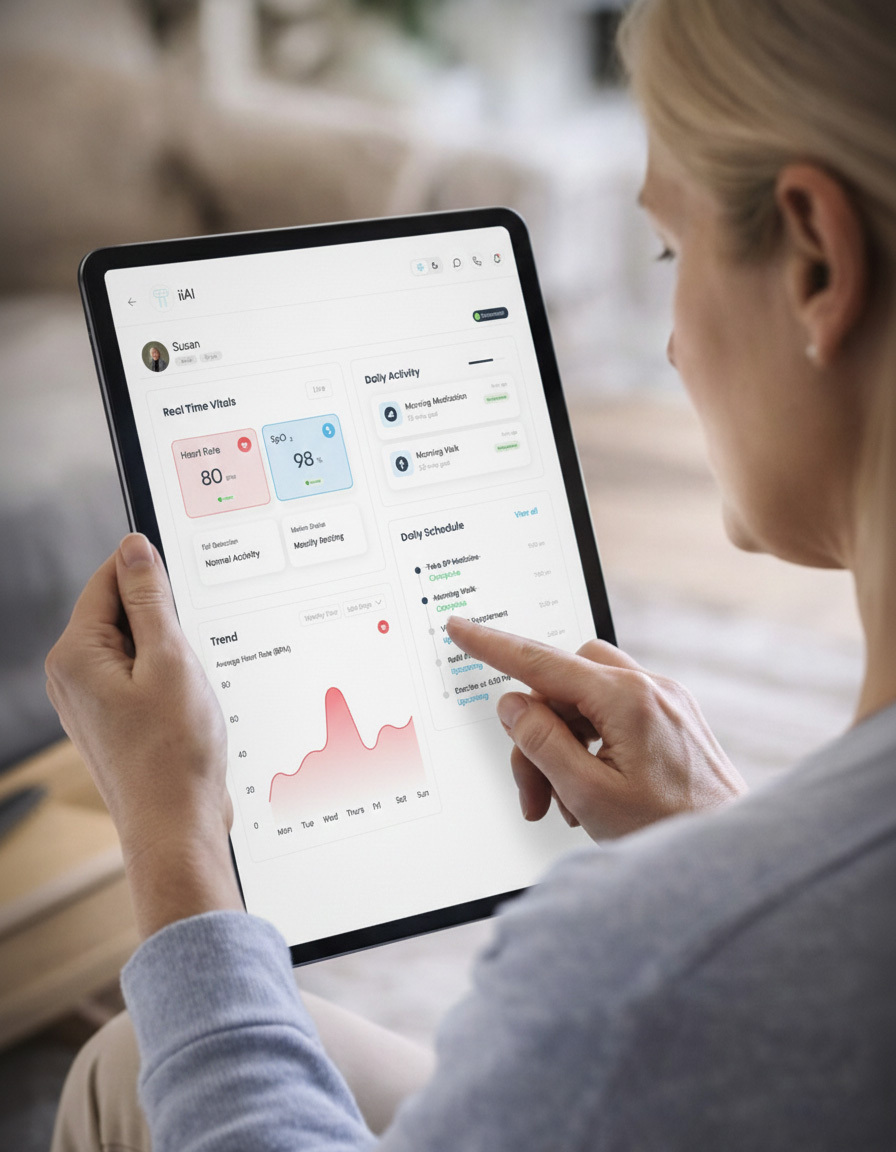
Learning What Care Really Requires
We are learning—day by day—what it truly means to care from a distance.
A camera shows us what is happening.
It doesn’t tell us what’s changing beneath the surface.
It doesn’t explain context.
It doesn’t help us understand what might come next.
It gives us visibility, but not insight.
And like many families, we often find ourselves wishing we understood more—not just what we’re seeing, but what it means.
Independence Matters More Than Control
Globally, we are living longer than any generation before us.
By 2030, more than 1 in 6 people worldwide will be over the age of 60. By 2050, that number will grow to over two billion.
And despite differences in culture, geography, and circumstance, most older adults want the same thing: to remain independent, in their own homes, for as long as possible.
More than 75% of adults aged 50+ express a preference for aging in place — not because it’s easier, but because independence is closely tied to dignity, identity, and a sense of self.
What we are navigating with our father—balancing safety, distance, and independence—is no longer unique. It is a reality now shared by millions of families.
Monitoring Helps. Understanding Protects.
Monitoring provides reassurance.
Understanding provides confidence.
Much of today’s technology stops at observation. It watches. It records. It alerts. But it rarely helps families interpret what they are seeing or make better decisions with less fear.
According to the Caregiving in the US 2025 Report, caregiving systems are under strain. In the United States alone, 63 million people now serve as family caregivers—providing tens of billions of hours of unpaid care each year while balancing work, children, and distance.
Technology helps. But it doesn’t always guide.
What we are learning is this: support systems need to do more than watch. They need to surface meaningful signals, provide context, and support judgment—without taking control away.
Multiply that experience across millions of families, and it becomes clear that this isn’t just a caregiving challenge. It’s a societal one.
The Longevity Economy Is Still About People
The global longevity economy represents trillions of dollars in economic activity. But reducing aging to a market misses what matters most.
It’s about living well.
Living safely.
Living on one’s own terms.
AI has the potential to support this—from early signal detection to caregiver coordination to adaptive environments. But only if it is designed with humility, intention, and respect for human judgment.
We are learning that power without care creates distance.
And technology without context creates anxiety.
Why iiAI Exists
iiAI was created from this space of learning—where possibility meets responsibility, and where we openly acknowledge that we don’t yet have all the answers.
We believe AI should:
- Support independence, not undermine it
- Help families and caregivers understand more, not worry more
- Assist human decision-making without replacing accountability
Our work is grounded in solutions that are:
- Human-centered
- Ethically grounded
- Transparent and thoughtfully governed
Not because there is a perfect solution — but because care deserves intention.
Staying Present, Together
We will keep checking the camera.
We will keep answering FaceTime calls.
We will keep learning as we go.
As families, leaders, and societies, we are learning how to care collaboratively across distance. The systems we build now have the opportunity to strengthen independence, support understanding, and help people age on their own terms.
That learning journey is at the heart of iiAI.
If this sounds like your dad, your mom, or someone you love—and you’re navigating how technology can support care, independence, and human judgment—you’re not alone.
Learn more at ii-goodai.com